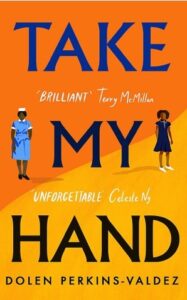
 I listened to Take My Hand by Dolen Perkins-Valdez on Audible. I got interrupted quite a bit so was slightly irritated when I missed key but that didn’t detract from my overall enjoyment of it and it is one of those novels that stays with you. It isn’t a difficult read, in fact the story-telling style makes it very accessible, but the subject matter is deeply unsettling and shines a light on a shameful moment in American history. Like Kristin Hannah’s The Women, which explores injustice through the lens of war, Take My Hand made me reflect on how little I know about the inequalities that shape lives and communities, and on how fiction can be such a powerful way of unearthing truths.
The story begins in Montgomery, Alabama in 1973, where Civil Townsend, a newly qualified nurse, is full of hope and determination. She is keen to make her own mark and, instead of following her father into medicine, takes a role in family planning where she believes she can help women take charge of their lives. Her first assignment is shocking: she is sent to administer birth control injections to two young sisters, India and Erica Williams, aged just eleven and thirteen. Neither child is sexually active, yet they are placed on unregulated drugs intended to prevent pregnancy. Civil quickly realises that something is terribly wrong, and her idealistic view of her new career begins to crumble.
Civil’s closeness to the Williams family is what gives the novel its power. India is quiet and withdrawn, possibly with developmental delays, while Erica is spirited and protective of her sister. Their father Mace is grieving the loss of his wife and trying to raise his daughters with dignity, while their grandmother shows resilience in the face of poverty and illiteracy. Civil does far more than her nursing duties, bathing the girls, comforting them, and building a bond of trust. This only heightens the devastation when the truth emerges: the girls have been sterilised, their father and grandmother having signed papers they could not read, with no understanding of what they were agreeing to.
Other relationships deepen the novel further. Civil’s mother June is an artist whose struggles with depression form a quiet backdrop to the story, reminding us that family burdens take many forms. Civil’s childhood friend Ty Ralsey reappears as both a source of comfort and moral questioning. Their relationship develops into romance, and when Civil becomes pregnant, she makes the difficult decision to terminate the pregnancy. This choice weighs heavily on her, mirroring the wider questions in the novel about autonomy, control, and the consequences of decisions made by and for women. Colleagues such as Alicia also add to the picture, encouraging Civil to see clearly the injustices around her.
What follows is a legal case that exposes the scandal of forced sterilisation, echoing the real-life Relf case. By fictionalising these events, Perkins-Valdez gives voice to the human side of institutionalised racism and medical exploitation. The novel is told in two timelines: the Civil of 1973, who is horrified as events unfold, and the Civil of 2016, now an established doctor, looking back on the choices that shaped her life and career. This structure is effective, reminding the reader how decisions in one moment of time can echo across decades.
While Take My Hand is a work of historical fiction, it reminded me strongly of Jodi Picoult’s Small Great Things. Both novels centre on nurses who find themselves caught in court cases that expose the intersection of medicine, law, and race. Both show how individuals, even those with the best intentions, can become complicit in systems that harm rather than protect. In Picoult’s story, a Black nurse is accused after the death of a baby; in Perkins-Valdez’s, a Black nurse grapples with her guilt after witnessing the sterilisation of children in her care. Each novel raises the uncomfortable question of who pays the price when prejudice and power collide.
Dolen Perkins-Valdez, already known for her acclaimed novels Wench and Balm (neither of which I have yet read, but now plan to), has spoken about her desire to tell stories that highlight overlooked histories. With Take My Hand, she wanted to ensure that the girls whose rights were stolen would not be forgotten, and that their story would reach a new generation of readers. Her writing is clear, compassionate, and vivid, capturing the oppressive Alabama heat, the rhythms of daily life, and the quiet but profound moments of intimacy between Civil and her patients.
Although the subject matter is harrowing, the book itself is not difficult to read. The narrative is direct and compelling, and the characters are drawn with warmth and humanity. For me, the most moving parts were the small acts of care Civil showed to the Williams sisters, gestures of kindness that contrasted so starkly with the brutality of what was done to them.
In the end, Take My Hand is an important and memorable book. It is easy to follow yet powerful in its impact, combining character-driven storytelling with historical truth. Like Kristin Hannah’s The Women and Jodi Picoult’s Small Great Things, it makes us consider how inequality operates and what it means to take responsibility. It is a novel that lingers long after the final page, not because it is rare or difficult, but because the injustice at its heart is iso important.