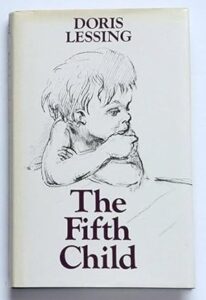
 I love Doris Lessing. The Golden Notebook is the title I always quote as my all-time favourite read. I have read it four times and each time it mesmerises me with its insight and hugely relatable characterisation of women. The social context I am less familiar with, but the portrayal of women is timeless and feels incredibly contemporary.
However, I am not reviewing The Golden Notebook, so I am not sure why I have waxed lyrical about it. Let us get to the book I am reviewing, which is The Fifth Child.
I came across it in a second-hand bookshop, and at £6.60 for a hardback it felt too good a bargain to miss. Typical Lessing, it is insightful, bold and full of that special quality she has, she can just read people. It is also deceptively simple and quick to read on some levels.
The book tells the story of Harriet and David Lovatt, their courtship and their desire to be loved and accepted. They are traditional and behind the times even for when the story is set. The novel was published in 1988 and takes place mainly in late 1960s and 1970s Britain. The Lovatts seem to have it all, a big house, financial support from David’s wealthy parents, and four reasonably well-adjusted children making their family feel complete. It is the kind of life you might see in a television series, somewhat chaotic, a bit strapped for cash, but still a comfortable middle-class academic existence.
However, when their fifth child is born, everything goes wrong. The child, Ben, is described as being too large, too clumsy, too feral and violent. He is almost a modern Frankenstein’s monster. The book then becomes an account of their lives unravelling, somewhere between a horror story and science fiction, yet the realism of the setting keeps us rooted in reality and makes us fearful of what family life can bring.
It is a compulsive read and made me think of modern gang culture. I think it hits me so powerfully because I come to it as a mum, thankful for my blessings. It is that “what if”, what if I had a child like that. The helplessness, the sense of things being beyond anyone’s control, makes it pervasive and eerie. And yet, the local ruffians in the village do manage Ben, and he does gain a kind of acceptance … of sorts!
I remember once listening to a radio interview with Lessing where she was somewhat scornful of people who studied her books and wrote PhD dissertations about them. I feel somewhat guilty then, even trying to pin down the story and what she was writing about. Family, definitely. Relationships and the effect children have, most certainly. Extended family and its role, yes. Diversity and difference, one hundred percent. Though aspects of the book, particularly terminology and some descriptions of Helen, the character with Down syndrome, would not, rightly so, get past an editor’s desk these days.
And yet, it is more than all of those things. I think it shows the strength of a mother’s love and also how challenging and destructive it can be, not just for the mother and child but for everyone around them. It makes us question our norms, and it makes us uncomfortable. It also transcends genres. I genuniely cannot pin it down, though I have tried. I do not think Doris Lessing would think I need to. But I will say this, it is brilliant, and I would recommend it to everyone.