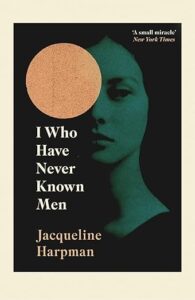
 I recently read I Who Have Never Known Men, another recommendation from one of my daughters, and was struck by how remarkably current it feels despite being written in 1995 by Belgian author Jacqueline Harpman. The story lingers long after the last page, touching on themes that remain relevant today.
The novel follows a group of forty women imprisoned in a cage, under constant surveillance, deprived of privacy, touch and escape. They are frequently drugged and completely controlled. One day a siren goes off, the guards vanish, and by sheer chance a key is left in the lock. The women escape. Once free, they search for other survivors and for signs of life in an unrecognisable landscape, possibly even a world other than Earth. For years they move cautiously, encountering no other survivors, until they eventually discover countless other groups of forty women imprisoned in the same way. Survival for the group being written about was pure coincidence.
The story is narrated by a young woman who has been imprisoned from infancy. Unlike the others, she has never known life before the cage, and this perspective shapes her understanding of the world. Early hints of a possible relationship developing with one of the guards quickly lose significance, and as the narrative develops male interest becomes almost irrelevant. Harpman emphasises how the women create a life independent of men.
Reading I Who Have Never Known Men, I realised it is never about figuring out what “actually happened.” Once I let go of that need, the novel opened up into something much larger, a quiet but sweeping meditation on existence itself. When I first tried to piece together why the women were imprisoned and what catastrophe had occurred that they were imprisoned in the first place I was constantly frustrated. It was when I stopped seeking literal answers that the story began to work on a profound allegorical level. It revealed itself as a meditation on confinement, resilience and human adaptability.
Harpman’s story asks what it means to be human when the world offers no guidance, no certainty, no structure, when everything familiar has been stripped away. The women survive, but survival is not just physical. I guess it is moral, emotional, and existential. They must invent meaning, invent connection, invent themselves in a landscape that is at once barren and indifferent. Once free, the women build relationships and networks of care among themselves. Friendships, alliances and love emerge in ways that highlight resilience, resourcefulness and strength. Their survival and sense of self are not contingent on men; they create meaning on their own terms.
For me, the novel lingers on the questions rather than the answers: how do we find purpose when there is none given, how do we sustain intimacy in isolation, how do we remain ourselves when all markers of identity are gone? In this sense, it is profoundly philosophical, almost unbearably so, and the freedom the women gain is inseparable from this reflection. It is freedom not only to move through the world, but to create a world within themselves, a life that insists on significance even in the absence of explanation. It is also captivity though and as it says in the book they are now imprisoned in the wider world, if not the cage, thus their lives, both before and after freedom from capture by the guards, becomes a representation of life itself. It’s because of this type of depth that it is the kind of book that I know will stay with me. It goes far beyond telling a story and kind of gives a strange emphasis and weight about being alive.
Harpman’s novel is unsettling but compelling. The imprisonment and subsequent freedom symbolise more than literal events; they reflect psychological confinement, societal pressures, gender dynamics and human cruelty. Through the narrator we are invited to consider how isolation shapes identity, how relationships are formed, and how humans adapt to extreme conditions. The lack of explanation about the world or why the women were imprisoned allows the story to operate on a symbolic level, making it both timeless and thought-provoking.