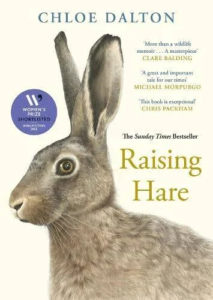
 I recently read Raising Hare Chloe Dalton having come across it in a rather unusual way. Forgive the back story, but it feels part of the experience of reading the book itself!
I was away on a very successful and heartwarming reunion with some old school friends, some of whom I genuinely had not seen for over forty years. Mad really. To stop any one person dominating proceedings or disappearing into endless detail, we were each given two minutes to summarise our lives before moving on. It was hilarious, slightly chaotic and actually rather moving.
Unsurprisingly, what emerged from my own two minutes was my love of books, so naturally we all began talking about what we were currently reading. A dear friend had just finished Raising Hare by author Chloe Dalton. If I am honest, the premise did not particularly excite me. I am not naturally drawn to non-fiction and a book about an executive working in London during Covid, living alone and rescuing a young leveret sounded, to me at least, rather steady. Added to that, revisiting Covid years still feels faintly stressful.
So imagine my feelings when, wandering around the lovely bookshops of Hebden Bridge during our reunion, Fiona bought a copy, wrote a dedication inside to our little merry gang and announced that we should all read it, post it on and effectively create our own travelling book club. I kept fairly quiet about my reservations regarding the book itself. The idea was whimsical and rather lovely, and the fact that I didn’t particularly relish reading that specific book suddenly seemed beside the point. After all, one of the real joys of book clubs is that they push us towards books we might never normally choose ourselves. Fiona handed the book to me first: somehow, it seemed, I had accidentally become involved in a third book club!
But here is the strange part. The day before I began reading, back home on what we call the Windies (bendy country roads near our home), a young leveret crossed directly in front of me. It was limping. The parallel with Dalton’s own encounter in the book felt so uncanny that I immediately decided this was clearly fate intervening and that I was now absolutely obliged to read Raising Hare with an open mind.
On the surface, Raising is quite literally a non-fiction book about a woman looking after a hare. That is essentially the plot. Yet somehow that description completely fails to capture what the book becomes.
For a start, I learned an astonishing amount. Embarrassingly, I did not even know a baby hare was called a leveret before reading it. Dalton herself enters this strange relationship knowing relatively little and repeatedly comments on how little has actually been written about hares compared to rabbits. Rabbits have been studied, bred, observed and domesticated endlessly. Hares remain elusive and oddly unknowable. Rabbits belong in children’s books. Hares belong in myths.
And myths they certainly inhabit. One of the interesting parts of the memoir is Dalton’s exploration of folklore surrounding hares and their long association with witches, moonlight and transformation. It is easy to understand why. Hares appear silently at dusk, vanish suddenly into long grass and can seem almost ghostlike in open fields. They live alongside humans yet remain untamed by us. Dalton quotes the idea that perhaps “the witch-hare’s true magic” is that it makes us briefly wish “to step out of the human form.” Oddly enough, I understood exactly what she meant.
What surprised me most was the tenderness of the relationship between the hare and Dalton. She never attempts to domesticate the hare and in many ways the entire book becomes about preparing for separation rather than attachment. She never even gives it a name, perhaps instinctively understanding that naming something is a way of claiming ownership over it.
And yet she utterly rearranges her life around this tiny creature. She tiptoes around her own home in the early hours so as not to startle it. Meetings, routines and travel begin to revolve around feeding schedules and safety in the same way life rearranges itself around a new baby. She watches constantly for signs of distress, danger or independence. Success itself becomes bittersweet because the goal is actually for the hare to no longer need her.
I found this unexpectedly emotional. Perhaps because I have written myself before about empty nesting and that strange parental contradiction of wanting something to thrive independently while simultaneously mourning the loss of being needed. Dalton captures that feeling beautifully. There is something deeply recognisable in watching a vulnerable creature slowly move away from you towards its own life. It reminded me at times of a toddler taking first steps or a child leaving home for university. Pride and grief seem to sit side by side.
The backdrop of Covid gives the memoir another layer entirely. I suspect many of us look back now and realise how strangely silent and lonely those years could feel. The world seemed temporarily paused, though I have since learned Dalton was learning in high pressure political environments. Perhaps the companionship of the hare becomes important precisely because it is so undemanding and non-verbal. Yet that companionship is also fragile because the hare fundamentally does not belong to Dalton’s world.
The book made me think quite a lot about why nature writing and animal memoirs are popular. It also made me question why I’ve not been drawn to them – I don’t know the answers! Books like H is for Hawk clearly tap into something many people are craving. Perhaps we all want slowness, observation and some sense of connection to a world outside our screens and anxieties. Covid, oddly, forced many people to stop rushing and start noticing. Birds seemed louder, or at least they did in Broughton woods, where I walked daily at those times. Seasons felt more visible. Small encounters with nature suddenly mattered again. Nature became healing in ways many of us had perhaps forgotten. I fear I’m getting carried away!
Despite its gentleness, Raising Hare also becomes surprisingly tense. Every delayed return feels ominous. Every dog, road, machine and fence begins to feel threatening. I became ridiculously emotionally invested in this fragile creature with its damaged leg. When the hare later has a litter of leverets, and some are injured or die, the sadness feels strangely profound. The natural world, Dalton reminds us, is beautiful but utterly unsentimental. There are even moments of gentle observation around gender and behaviour. The male leveret appears noticeably bolder, brasher and more adventurous in its explorations of the surrounding landscape, while the females seem more cautious and watchful.I also loved the way Dalton writes about hares themselves. They remain mysterious throughout. Unlike rabbits, they resist containment. They do not really adapt themselves to human spaces. The wildness stays intact. That, ultimately, is what makes the relationship so moving.
There are moments in the memoir where Dalton almost begins living according to the hare’s rhythms rather than ordinary human routines. The book becomes full of silence, dusk, careful observation and listening. It slows the reader down too. You begin noticing sounds, weather, shadows and movement differently.
I live overlooking fields where perspective does a strange thing. Weirdly, animals far away sometimes appear larger rather than smaller. More than once I have convinced myself I was seeing deer on the horizon only to later realise they were hares. Deer are frequent visitors too, but since reading Raising Hare I find myself looking at the fields differently. More attentively perhaps.
Towards the end of the memoir Dalton makes a plea for the preservation of hedgerows and habitats, arguing that these creatures have as much right to the land as we do. This felt particularly important to me. The book quietly reminds us how much of the natural world survives precariously alongside modern farming, roads and development. The hare itself becomes symbolic of something ancient, vulnerable and increasingly displaced.
I began the book doubtful that a memoir about a hare could possibly hold my attention. Quietly, gently and entirely without fuss, it absolutely did.