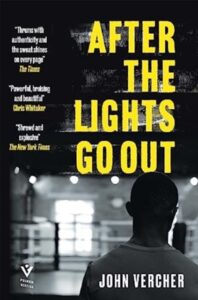
 After the Lights Go Out by John Vercher was chosen for our book club by a young male member. I have to admit that I read the whole book without really knowing what cage fighting was. I genuinely imagined a small metal cage in which two reluctant semi-athletes would fight.
It isn’t the first time on this blog that I’ve had to apologise for my ignorance. Once I’d read the book and looked up what MMA fighting actually is, I at least had a more realistic context in which to place the events of the story. And yes, despite my ignorance and probably some prejudice against a sport I knew nothing about, I enjoyed the book.
The outline of the story is fairly straightforward. The protagonist, Xavier “Scarecrow” Wallace, is a biracial MMA fighter who has been suspended from the sport for a year after taking performance-enhancing steroids. As he nears the end of his suspension, he returns to training with his manager, who is also his cousin Shot. Their relationship is complicated, with Shot both protective and pushing Xavier toward fights and decisions not in his best interest. At the same time, Xavier is ill and, although he doesn’t yet have a name for it, is dealing with a fight-related dementia brought on by repeated fighting injuries.
Alongside this, Xavier is caring for his elderly white father, who has Alzheimer’s and no longer has the filters that may once have concealed who he really is. We see Xavier’s unravelling: his violent outbursts, his confusion, and his increasing difficulty managing many aspects of his life. He is far from a perfect character, and yet he remains extremely likeable.
It’s here that I want to pause and make what may seem like an odd comparison to The Diaries of Jane Somers by Doris Lessing, which I’ve also read recently. These are two books, and two protagonists, that could hardly be more different. Yet in both, it is the exposure of flaws and the unvarnished reality of the characters that makes them work.
This strength in characterisation ultimately allowed me to enjoy a book that, at first, I thought would not immerse me at all.That’s not to say the writing here is of the same quality as Lessing’s – it isn’t, it couldn’t be. She is pure genius. At times, Vercher’s writing is repetitive and simplistic, and the same points are driven home more often than necessary. But it is effective, and it is far better than I expected it to be.
Characterisation is, of course, often used to explore theme, and in this book it is racism, violence, loyalty, family, and mental illness that take centre stage. These themes are frequently explored, but I’ve never read about them in the context of a physically violent sport before. As I said, the book challenged many preconceptions I have about what I might enjoy and what I believe.
The story also explores the hidden world of violence and corruption in MMA. Beyond the fights themselves, the book exposes the underside of the sport, the influence of managers and promoters, and the pressure to succeed at any cost. There is cheating, coercion, and moral compromise, which serves as a backdrop to Xavier’s personal struggles and makes the story feel grounded in a world that is morally ambiguous as well as physically dangerous.
Interestingly, there is no traditional love interest in the story. This is a male author writing a book largely about a “man’s world”. Having said that, the relationship between Xavier and his mother is one of the more subtle and compelling threads. It is shaped by history and distance, by what has been left unsaid, and by the ways both mother and son navigate their own vulnerabilities. Over time, Xavier comes to realise that the difficulties of their relationship were not his mother’s fault, which adds depth and poignancy to their interactions. Xavier’s reactions to the female care home manager, Mrs Thomas, highlights the collision between his sense of responsibility and his emotional impulses, enhancing the nuanced portrait of his character.
A stylistic element I found fascinating is Xavier speaking to himself as if he were a different person. These passages are set apart in the text, and I wondered whether these voices become significant in leading to the final action in the book. They might also reflect the effects of his dementia, blurring the line between internal dialogue and an alternate perspective on his own life.
The story arc of After the Lights Go Out is effective, and the ending is dramatic and direct. As a reader, it has become a joke that I always read the last couple of pages of a book when I am only partway through it. It doesn’t often matter, but in this book it does. The resolution, which could almost be mapped as the climax, is certainly dramatic and key to the story. Note to self: reading the end sometimes, and this time did, spoil the story.
The blurb on the book cover from The New York Times describes After the Lights Go Out as “shred and explosive.” I think that is spot on and entirely appropriate for a book about violence and high-stakes action. I had never really read any American noir fiction before and to be perfectly honest I didn’t really know what it was. It is gritty, urban, and ethically murky. The book is full of existential despair, but it is also at times human, warm, gentle, and inviting. I would definitely read further books by John Vercher, despite the context of the action being so alien to what I would normally pick up.