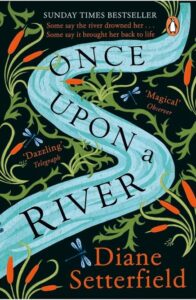
 Once Upon a River by Diane Setterfield is a novel that lingered with me long after I had finished it. From the very beginning, on a snowy winter’s night at the Swan Inn, the narrative captures the reader with a sense of both mystery and quiet foreboding. A badly injured man, Henry Daunt, arrives carrying a little girl who appears dead, and hours later she revives.
The child’s identity is unknown, and three very different families come forward to claim her. Helena and Anthony Vaughan believe she may be their long-missing daughter Amelia. A gentleman farmer, Mr Armstrong suspects she is connected to his son, Robin, while Lily White, the parson’s housekeeper, believes the child could be her drowned sister.
Setterfield spends considerable time exploring each family’s grief, desire, and the ways loss shapes human behaviour. The child herself remains largely silent, a mirror reflecting the adults’ fears, hopes, and moral complexities. The novel does not rush to resolve these claims but allows the reader to consider the ethical and emotional consequences of hope, longing, and attachment.
It quickly became clear to me that the story’s power lies not merely in the miraculous event itself, but in how Setterfield explores the ripple effects of that single moment on multiple lives, revealing key aspects of character and illustrating how unexpected events can profoundly shape individuals in different ways.
The way Rita Sunday, the local nurse, and Henry Daunt, a recovering photographer, are drawn into the mystery illustrates this. Rita approaches the child with rationality and care, seeking explanations grounded in observation and medical knowledge, while Daunt is more intuitive and open to the extraordinary. Their developing connection adds warmth and human intimacy to a story that is often filled with grief, suspense, and moral ambiguity. For me, their relationship emphasised the ways trust, compassion, and curiosity coexist alongside uncertainty and fear.
One of the most mysterious aspects of Once Upon a River is the legend of Quietly, the mysterious ferryman of the Thames. Quietly appears at moments of life, death, or danger, and Setterfield treats this folklore with seriousness, weaving it seamlessly into the narrative alongside realism. It is he, who ultimately does hold the key of the little girl and without spoiling the end ultimately holds the answers we are looking for.
Additionally, the river itself functions as a living, dynamic presence. It carries memory, danger, and possibility, shaping the lives of all who encounter it. For me, the Thames is almost a character in its own right, embodying the novel’s themes of fate, mystery, and transformation. Its mystical or fairytale qualities appear elsewhere in literature too — for example, in my review of The Clockmaker’s Daughter, I show the river Thames as being both atmospheric and symbolic, carrying secrets, history, and moments of suspense.
Setterfield’s narrative style is deliberate, immersive, and richly atmospheric. The prose is lyrical and slow-paced, giving space for reflection while capturing the tension and beauty of each scene. The narration shifts perspective among multiple characters, often using free-indirect discourse, allowing readers to inhabit the thoughts and emotions of each character while maintaining ambiguity. Non-linear elements, including flashbacks and digressions, enhance the sense of a story being told as if around a fire or in a quiet inn, layering history, memory, and legend. This structure mirrors the thematic concerns of the novel, emphasising storytelling as a way to understand human experience, to bear witness to grief, and to navigate moral complexity.
Themes of storytelling, grief, love, identity, and belonging run throughout Once Upon a River. The novel interrogates how identity is constructed, how communities and families shape our understanding of self, and how loss can influence desire and perception. The child’s ambiguous identity forces both characters and readers to consider the meaning of belonging and the ways in which myth and story can console, guide, or even mislead us. The tension between science and superstition is present throughout, reflecting the historical context and deepening the novel’s meditation on the limits of human understanding.
For me, reading Once Upon a River felt a little bit like a literary hug that I wasn’t quite sure I was ready for. It was gentle, yet compelling and at times unsettling. It offered an immersive experience that encourages reflection on human emotion, narrative, and the power of stories.
It is a novel to be savoured slowly, where the mystery of the child is inseparable from the rich emotional landscapes of the characters and the river that binds them. The book lingers, inviting readers to consider how grief, love, and memory shape the lives we live and the stories we tell.