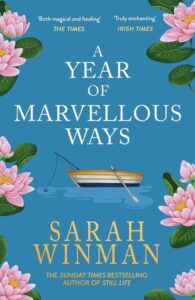
 A Year of Marvellous Ways is Sarah Winman’s second novel, published after her much-loved debut When God Was a Rabbit (review here) and before the heartbreaking Tin Man (review here) and the sprawling and luminous Still Life (review here). Looking back across her writing I can see a clear thread of lyricism and poetry that sets Winman apart. She has this way of moving characters through decades of history, often against sweeping backdrops, while still keeping their lives intimate and personal.
What feels different in A Year of Marvellous Ways is her use of magical realism, and I think this is what made it both intriguing and at times a little challenging. The story opens with Marvellous Ways, an eccentric and elderly woman who lives alone in a hut beside a Cornish creek. She spends her days by the river, waiting for something to happen, watching the tides and telling herself stories of mermaids and fate. Into this quiet world stumbles Francis Drake, a traumatised young soldier who has returned from the Second World War carrying grief, heartbreak, and a promise to deliver a dying comrade’s letter to his father.
The novel gradually winds the two lives together. Francis is exhausted, quite literally collapsed by the river when Marvellous finds him, and she nurses him back to health. In doing so she shares with him her own life stories, tales of lost loves, fleeting moments of joy, and her belief in destiny. Alongside this, other figures appear such as Peace Rundle, whose solid presence and quiet strength give the narrative a grounded counterpoint. Like Winman’s other books, the characters are unapologetically flawed and raw, yet also tenderly drawn. I liked that the relationships never slipped into predictability. I fully expected Peace and Drake to end up together, but Winman resists that sentimental resolution, reminding us instead that life is rarely so tidy.
And yet, despite reading every word, I sometimes felt the book slipping away from me. I can remember flashes of the hut by the water, the coast, a bridge built near the end, Drake as rugged and broken, Marvellous as floaty and perhaps even a little grubby in her solitude, but the imagery has not stayed with me in the way the vivid London of When God Was a Rabbit or the post-war Florence of Still Life has. The whole story feels dreamlike, as though told through half-remembered mist, which I suppose is part of its design but left me personally a little adrift.
Still, there is beauty here. The novel is about grief, recovery, and the power of storytelling to carry us through both. Marvellous herself becomes less a character and more a vessel, someone who embodies the idea that we live on in the tales we tell and the connections we forge. Through her, Francis finds not only rest but also a way forward. Their companionship feels tender, unexpected, and healing, and Winman reminds us once again of the redemptive power of kindness and memory.
I will admit I occasionally found the narrative elusive, and I am almost certain I missed or misunderstood parts of the plot. This is one of those novels I would love to discuss at a book club, just to see if others pieced it together differently. Unlike the warmth and humour I felt reading When God Was a Rabbit, or the emotional punch of Tin Man, or even the expansive generosity of Still Life, here I found myself struggling at times to hold on to the threads. That said, for readers who enjoy prose that borders on the poetic and who do not mind a touch of magical realism, A Year of Marvellous Ways will be a rich and rewarding experience.