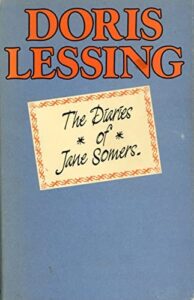
 I started reading The Diaries of Jane Somers just before Christmas and finished it today. What a brilliant book. It served as a powerful reminder of why Doris Lessing is my absolute favourite author. She is a wonderful writer.
The Diaries of Jane Somers were originally published as two separate novels, The Diary of a Good Neighbour in 1983 and If the Old Could … in 1984, both under the pseudonym Jane Somers, which was in fact Doris Lessing. Lessing later explained that she used the pseudonym as an experiment, wanting the novels to be judged on their own merits rather than benefiting from her established reputation, and also to highlight how difficult it can be for unknown writers to get published. The two books were later brought together in a single volume titled The Diaries of Jane Somers, this time with Lessing’s name attached after she revealed her authorship.
Lessing made clear that the novels are not autobiographical, though they draw on her experiences of how older people are treated and on broader social inequalities. The protagonist, Jane, known as Janna Somers, is a successful editor of a fashion magazine who is initially absorbed in her career, image and comfort. Over time, her life changes as she confronts loneliness, ageing and the realities of caring for others.
In the first book, The Diary of a Good Neighbour, we are introduced to Janna as someone who has been distant from her family and who recognises that she was a poor carer to both her late husband and her mother. After a chance meeting in the street with an elderly woman, Maudie Fowler, Janna becomes involved in Maudie’s life, first as a neighbour and gradually as a carer and friend. Through this relationship, beautifully rendered by Lessing, themes of ageing, connection and empathy emerge. Janna’s strained relationship with her sister Georgie, and the dynamics involving Georgie’s daughter Jill, add further depth to the narrative. Lessing is careful to present all her characters as flawed, challenging stereotypes around ageism, loneliness, success, friendship and family. The book feels like an intimate snapshot of one middle-aged woman’s life and, through that lens, prompts reflection on wider societal assumptions. It is brilliant.
In the second book, If the Old Could …, the focus shifts towards love and relationships later in life. Janna enters into an intense but unphysical relationship with Richard, a middle-aged marriage counsellor, and they attempt to keep their personal lives separate from the relationship itself. This becomes increasingly difficult, particularly as the younger generation comes more sharply into view, including Richard’s children and Janna’s niece Kate, who has moved in with her. The interplay between generations, and their differing approaches to love, intimacy and responsibility, becomes central to the story.
There are aspects of the book that are uncomfortable to read now. The portrayal of Janna’s niece Kate, who has Down syndrome, relies on language and attitudes that feel inappropriate and offensive to a contemporary reader. While it could be argued that this reflects the character’s perspective rather than the author’s endorsement, it still sits uneasily and disrupts my empathy as a reader. I understand the instinct to contextualise this as a product of its time, but that does not entirely excuse it for me. This tension becomes something to sit with and reflect on. How do we engage with works that are intellectually rich and emotionally generous, yet contain elements that now feel exclusionary? The novel also explores Janna’s limited understanding of her niece Hannah’s sexuality and Richard’s reactions to it, reinforcing Lessing’s commitment to portraying characters who are imperfect, inconsistent and deeply human.
Despite the above reservations, overall, I adored this book and, aside from the troubling language around disability, it has earned a place among my very favourites. There is so much to reflect on and discuss, and it showcases the immense intelligence of Doris Lessing. I find myself wishing I could ask her how she would respond to my discomfort with aspects of her portrayal of disability, though of course I cannot. It has been a wonderful way to begin 2026, with a reading experience that is both fulfilling and profoundly thought provoking.