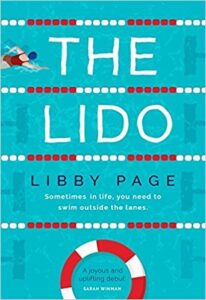
 This was another book I read because it was a book club choice. It had been selected by a good friend from my book club, so I was very pleased to be able to report favourably on it both to my main book club and to an online reading group I’m part of. In that online group, we simply support and encourage each other’s reading by sharing what we’ve read. Our goal for 2025 is 25 books, a target most of us have already surpassed. When I added Libby Page’s The Lido to the online chat, I summed it up as ‘easy, predictable, and sweet’.
The book is based in Brixton, South London, and I imagine for local people it was a delight to have real places brought to life so vividly. It is a book of now and yet gives a valuable nod to history, heritage and the ability for diverse communities to come together positively and meaningfully. The premise is one of saving a council-owned lido that a modern developing company, A company, Perfect Place, wants to buy up the lido in order to build a set of designer apartments complete with tennis courts etc. that are for the exclusive use of the owners of the complex apartments. This struck a chord as my own daughter lives in Walthamstow, East London, and I’ve seen similar modern building complexes there where perhaps a very similar process has been undertaken in gentrifying this area of London too.
The Lido is a book of contrasts and comparisons with old juxtaposed against new throughout. It is perhaps a little unsual as there are two protagonists, the elder one being Rosemary Peterson, and the younger one being Kate Matthews. Rosemary is born and bred in Brixton. She met the single love of her life, George Peterson, at only 16 and their love story really is one without barely a cross word. The local lido, close to the tower block apartment where they lived, was central to their courtship and whole life, and as Rosemary navigates grief and old age it is essential to her. Through Rosemary the novel addresses heavy issues such as miscarriage, loss, illness, and death in a believable and unobtrusive way, reflecting the subtle portrayal of the relationship between Rosemary and Kate.
Although Rosemary is older and Kate is younger, they share much in common, and their friendship highlights this bond. As the story progresses, Kate begins to take a more central role, showing how their lives and experiences are connected despite their very different backgrounds. As a young graduate of journalism she takes a role at the Brixton newspaper and spends most of her time reporting on minor stories of missing cats and so on. That is until she becomes involved in saving the lido that has been such a strong part of Rosemary’s life.
The saving of the lido is metaphorical in that it is also the saving of Kate, who at the beginning of the novel is a lonely young woman making her way in London. It is also hugely important to various other minor characters in the book, from bookshop owners, to students, to parents. Everyone has different stories and memories associated with the lido. And for each the act of swimming in its chilly water brings its own comfort.
The book was quick and easy to read. It reminded me very much of other books of salvation and connection, A Man Called Ove sprang to mind. I started the review by saying it is easy, .predictable and sweet. and it is, but that is not to diminish it. A well-structured story with such a clear plot trajectory can easily become twee and this avoids that. It also offers quite the social commentary, if a somewhat idealised one. I would definitely recommend this book for someone on a long train journey, on a sunlounger, or for someone who loves swimming and will relate to the positive serotonin buzz that comes with swimming and standing up for something you believe in.