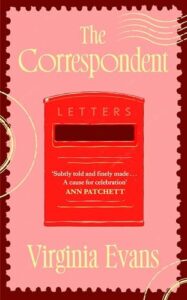
 Honestly, I’ve read so many brilliant books over the last couple of months (it feels like a golden age for fiction!), but I haven’t found time to blog about any of them. That’s partly because I’ve been busy getting ready for my new bookshop, The Book Stop in Brigg. However, it is important that I still make time to write about the books that really matter to me. The Correspondent by Virginia Evans is one of them.
When The Correspondent was announced as the winner of the Women’s Prize for Fiction last week, I was so pleased. I also felt a bit smug about having already read it and loved it.
So, to the book.
Virginia Evans’ The Correspondent tells the story of Sybil Van Antwerp, a retired lawyer in her seventies whose life is revealed through a series of letters. Inevitably, it brought to mind Alan Bennett’s A Lady of Letters. There are similarities. Both women are intelligent, observant and not afraid to express an opinion. Yet Sybil is a far more complex and emotionally wounded character and, of course, we are reflecting on a full-length novel.
One of the joys of The Correspondent is its epistolary format. Letters are such an accessible way to tell a story. They feel light, simple and easy to read. Consequently, the novel is slightly deceptive. You find yourself rattling through the pages, only to realise that beneath the surface lie some really serious themes.
As I read, I found myself thinking about how different letters are from emails or texts. They encourage reflection. People choose their words more carefully. They reveal something about the writer. In many ways, the letter form feels perfectly suited to a novel about memory, relationships and the stories we tell ourselves.
However, I also liked the fact that Evans doesn’t confine herself entirely to letters. Some of the email exchanges are equally revealing. Through Sybil’s correspondence with Basam Mansour, she explores the experience of migration and the frustration of possessing skills, qualifications and expertise that are not always recognised in a new country. Although this is not the novel’s central focus, it is an important strand of the story and adds another layer to Evans’ exploration of identity, belonging and what it means to be truly seen by other people. What makes this strand of the novel particularly interesting is the way Sybil’s own unconscious biases and prejudices are gradually explored and acknowledged by both herself and Basam.
Grief sits at the heart of the book. We learn early on that Sybil’s son Colt died as a child. Decades later, his absence still shapes almost everything around her. This is not a novel about getting over loss. Rather, it is about learning to live with it. Colt’s death is not something Sybil leaves behind. Instead, it becomes woven into the fabric of her life.
Her marriage eventually collapses under the strain of bereavement, and perhaps nowhere is the impact felt more strongly than in her relationship with her daughter, Fiona, who lives in California. The two women clearly love one another deeply, yet there is something that prevents them from communicating freely and honestly. Both seem reluctant to disturb the fragile balance they have established over the years.
Many mothers and daughters will recognise something of this dynamic. I’m fortunate to have a wonderful relationship with both my girls, but even so, I understood Sybil’s reluctance to rock the boat and say the things that perhaps most need saying.
As the novel unfolds, we begin to realise that Sybil is not always the most reliable narrator. The comparison that came to mind for me was Stevens, the butler in The Remains of the Day. Both characters tell their stories with apparent honesty, yet both reveal far more than they perhaps intend.
One of the things I loved most about the book was the way Sybil becomes increasingly multi-dimensional. Through her letters to family, friends, neighbours, former colleagues and even authors she admires, we see different aspects of her personality emerge. She can be funny, stubborn, generous, controlling, insightful and occasionally blind to her own shortcomings. She feels entirely real.
I do enjoy books about older characters and ordinary lives. Readers of this blog may remember my reviews of Olive, Again and Three Days in June. Although very different novels, all three share an interest in the hidden emotional lives of ordinary people. This novel does it particularly well.
In fact, until yesterday, it was my book of the year. Now I’m not quite so sure, having just finished Tell Me Everything. If you’ve read my review of Olive, Again, you’ll know that I have something of a soft spot for Elizabeth Strout. Now, I’m genuinely torn between the two, although I haven’t yet written my review of Tell Me Everything.
If you enjoy letters, warmth, complex characters, humour, sadness and stories that linger long after the final page, then I can’t recommend The Correspondent highly enough. It is utterly brilliant!